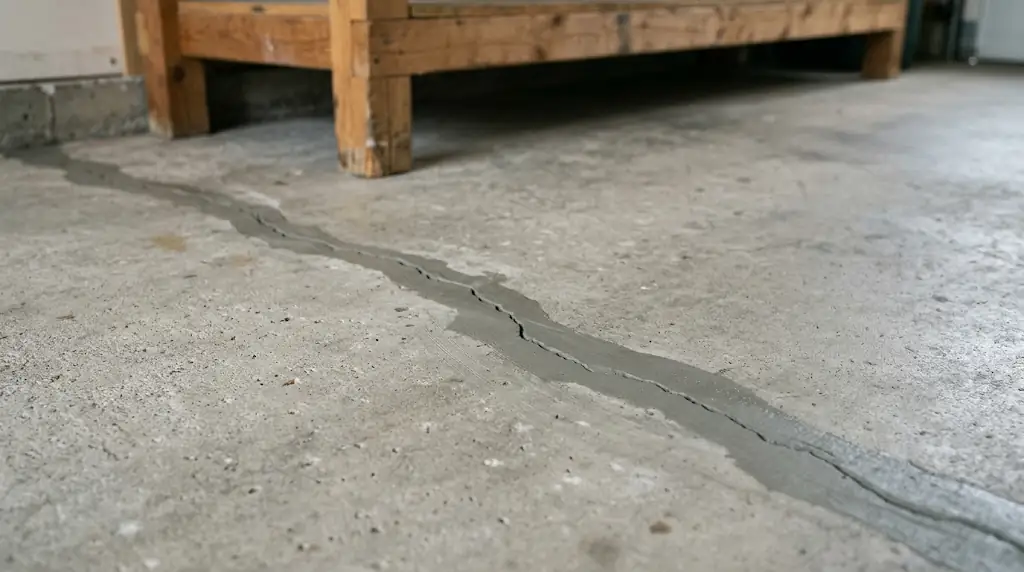
Yes, you can put an epoxy coating over cracked concrete, but the damage must first be permanently stabilized and filled using an industrial-grade polyurea joint compound. Applying any liquid coating directly over open cracks guarantees that the new floor will tear along the exact same fault lines as the slab shifts.
To achieve a flawless, permanent garage floor in the Kansas City metro, professional installers treat concrete repair and concrete coating as two distinct, mandatory phases of the project. The longevity of your epoxy or polyaspartic floor relies entirely on the structural integrity of the concrete beneath it.
Why Johnson County Concrete Cracks So Aggressively
Concrete does not crack without a catalyst. In Eastern Kansas, that catalyst is the dirt sitting directly beneath your home.
Johnson County sits on some of the heaviest clay in the metro, specifically Wymore-Ladoga clay. Local foundation specialists at JLB Foundation Repair note that this specific soil profile contains 60 to 80 percent clay, earning a “very high” shrink-swell rating from the USDA. Furthermore, the Kansas Geological Survey identifies expansive soils as a pervasive, statewide problem. During dry periods, water trapped within these clay layers evaporates, causing the soil to shrink aggressively.
For slab-on-grade foundations and garage floors, this cyclical expansion and contraction leaves voids beneath the concrete, allowing gravity to accelerate settling and cracking. As noted by Heartland Foundation Repair, the ground beneath your garage in Olathe, Overland Park, or Lenexa swells after rain and shrinks in the dry heat. This movement exerts immense tension on rigid concrete slabs, snapping them into sections.
Identifying the Types of Concrete Cracks
Before applying any coating, a professional installer will evaluate the type of cracking present in your garage. Not all fractures require the same repair protocol.
- Plastic Shrinkage Cracks: These are fine, hairline cracks that formed when the concrete was originally poured and cured too quickly. They are superficial and do not threaten the structural integrity of the slab.
- Settlement Cracks: These are wider, deeper cracks caused by the Wymore-Ladoga clay shrinking and leaving a void beneath the slab. One side of the crack may sit lower than the other.
- Heaving Cracks: Formed when saturated clay expands and pushes upward against the concrete. These often present as long, jagged faults running across the center of the garage.
- Spalling and Pitting: Surface-level craters caused by freeze-thaw cycles and winter road salts destroying the top layer of the concrete paste.
The Professional Crack Repair Process
Hardware store DIY epoxy kits fail because homeowners are instructed to simply paint over existing cracks or fill them with cheap acrylic caulk. Acrylic caulk shrinks, dries out, and easily separates from concrete.
Professional floor coating companies execute a rigorous, mechanical repair process before a single drop of epoxy is mixed.
- Chasing the Crack: Installers use a heavy-duty angle grinder equipped with a diamond V-blade to trace the entire length of the crack. This opens the fracture, removes loose debris, and creates clean, porous vertical walls for the repair material to bond against.
- Vacuuming and Preparation: High-velocity industrial vacuums remove all silica dust from the chased trench. The crack must be completely devoid of dust and moisture.
- Applying Polyurea Filler: Installers inject a two-part, rapid-curing polyurea joint filler deep into the crack, slightly overfilling the trench. Polyurea cures exponentially harder than standard concrete but remains flexible enough to absorb microscopic subterranean vibrations.
- Mechanical Grinding: Once the filler is fully cured, large walk-behind planetary grinders equipped with diamond tooling are run over the entire garage floor. This shaves the overfilled cracks perfectly flush with the surrounding slab, creating a completely seamless surface.
DIY Crack Fillers vs. Professional Polyurea
The chemical composition of your crack filler determines whether your new floor will last one year or twenty years.
| Filler Material | Flexibility | Bonding Strength | Verdict for Epoxy Prep |
| Acrylic Caulk | High | Very Low | Fail. Shrinks over time and repels epoxy resin, causing delamination along the crack line. |
| Pre-Mixed Concrete Patch | Zero | Moderate | Fail. Cures brittle. The exact same soil movement that caused the first crack will easily snap the rigid patch material. |
| Standard Epoxy Paste | Low | High | Poor. Bonds well but lacks the necessary flexibility to survive aggressive Kansas freeze-thaw cycles. |
| Industrial Polyurea | Moderate | Extreme | Optimal. Bonds at a molecular level with the ground concrete. Flexes enough to survive seasonal soil shifts without tearing the topcoat. |
Can an Epoxy Coating Stop Future Cracks?
No chemical floor coating can prevent a concrete slab from cracking if the ground beneath it fails. An epoxy or polyaspartic floor system is a highly durable protective barrier against chemicals, moisture, and abrasion, but it is not a structural foundation repair.
If your home in Shawnee, Gardner, Leawood, or De Soto is experiencing severe, active foundation sinking where the concrete drops several inches, you must hire a mudjacking or foundation repair specialist to stabilize the subgrade before installing a cosmetic floor coating.
However, for standard settlement and shrinkage cracks that have largely stabilized, a professional polyaspartic coating system acts as a high-tensile bridge. The polyurea joint filler absorbs the minor seasonal shifts of the Kansas clay, and the heavy, flexible polyaspartic topcoat stretches just enough to prevent hairline fractures from telegraphing through to the surface.
Do Not Let Cracks Ruin Your Investment
Coating a garage floor requires precision chemistry and heavy mechanical preparation. If you ignore the cracks, the epoxy will fail. If you prep them poorly, the epoxy will fail.
You need a localized solution engineered for the specific challenges of Johnson County clay and Kansas City weather. We assess the structural health of your concrete, execute permanent repairs, and lay down industrial-grade coatings designed to last.
Contact Olathe Epoxy Flooring to get a clear, honest assessment of your cracked concrete. Visit our contact page to schedule your free on-site measurement and project quote today.