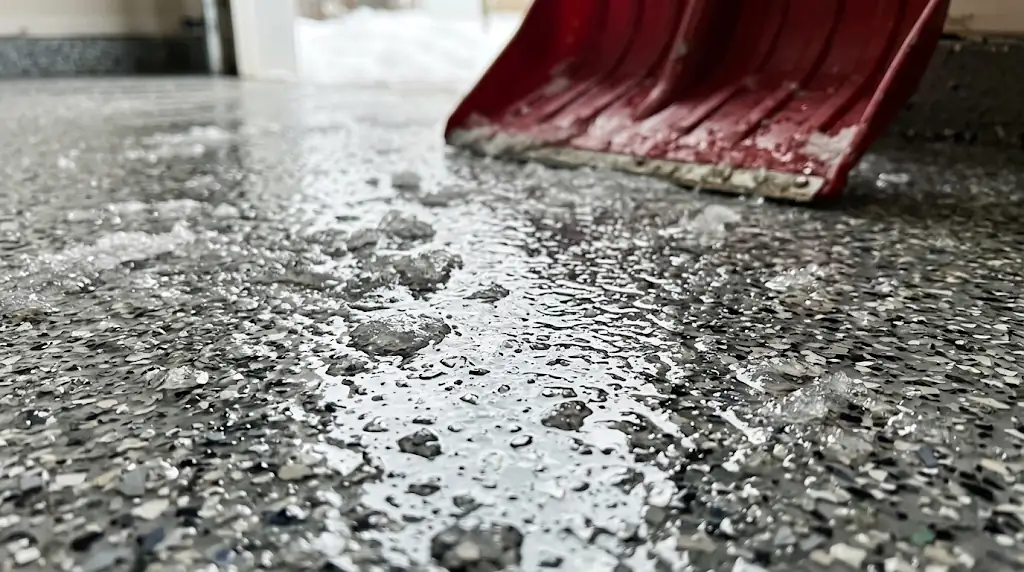
A standard, solid-color epoxy garage floor is dangerously slippery when wet from Kansas snow and rain. However, professionally installed polyaspartic systems utilizing a full-flake broadcast create an aggressively textured, slip-resistant surface that exceeds federal safety standards for traction.
When a standard epoxy resin cures, it creates a completely non-porous, plastic-like sheet. When rain from heavy spring thunderstorms or melting snow from a Johnson County winter covers this smooth surface, it creates a thin liquid barrier between your shoes and the floor. This eliminates all mechanical friction, turning your garage into an extreme slip hazard. To safely navigate your garage in wet weather, you must install a coating system engineered with a physical surface profile.
Federal Slip Resistance Standards: OSHA and ANSI
Professional floor coating installers do not guess at what makes a floor safe. They engineer the surface profile to meet or exceed specific federal and national safety metrics regarding traction.
Traction is measured using the Coefficient of Friction (COF), which is a numeric value representing the friction between two objects. There are two primary standards used to evaluate garage floor safety:
- Static Coefficient of Friction (SCOF): The Occupational Safety and Health Administration (OSHA) recommends that walking and working surfaces have a static coefficient of friction of at least 0.5. This measures the force required to initiate movement from a stationary position.
- Dynamic Coefficient of Friction (DCOF): DCOF testing is used to specify the friction of an object that is already in motion. The results of DCOF testing determine the likelihood of whether a surface could contribute to someone slipping and falling. The American National Standards Institute standard ANSI A326.3 is the benchmark for accurately determining the DCOF on hard surface flooring. This standard mandates that level interior spaces expected to be walked upon when wet must maintain a wet DCOF of 0.42 or greater.
To measure these exact safety metrics, the industry utilizes the BOT-3000E, an advanced digital tribometer designed to crawl along the floor at a constant speed to calculate the slip resistance without human input.
Comparing the Traction of Garage Floor Surfaces
Understanding how different flooring profiles perform under wet Kansas conditions is critical for homeowner safety.
| Garage Floor Surface | Wet Slip Hazard Level | Meets OSHA 0.5 SCOF? | Best Use Case |
| Bare Troweled Concrete | Low | Yes | Uncoated utility spaces. |
| Solid-Color Smooth Epoxy | Extreme | No | Dry interior showrooms only. |
| Light-Broadcast Flake | High | Unlikely | Budget aesthetic upgrades. |
| Full-Broadcast Flake (Polyaspartic) | Low | Yes | Standard residential garages in Johnson County. |
| Full-Flake + Aluminum Oxide | Zero | Yes | High-traffic commercial shops and steep inclines. |
For homeowners in Olathe, Overland Park, and Lenexa, a standard solid-color floor is a massive liability. When you carry groceries from your vehicle into the house while wearing wet boots, you require a floor that guarantees a DCOF well above the 0.42 minimum.
How the Full-Flake System Creates Traction
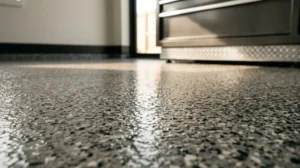
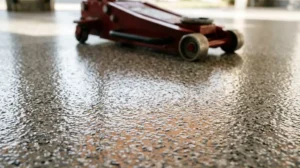
To defeat the dangers of smooth resin, professional installers apply a full-flake broadcast system. This process physically alters the topography of the floor coating, providing mechanical grip for your footwear.
- The Base Coat: The installer rolls down a thick base layer of polyurea or epoxy resin.
- Point of Rejection Broadcast: While the base coat is still wet, decorative vinyl chips (flakes) are thrown onto the floor until the resin is completely covered. 100% of the wet floor is buried in vinyl flakes.
- Mechanical Scraping: Once the base coat cures, the installer uses a flat metal floor scraper to knock down the sharp vertical edges of the protruding flakes.
- The Clear Topcoat: A heavy-duty polyaspartic clear coat is rolled over the scraped flakes.
Because the flakes overlap each other randomly, they create a distinct “orange peel” texture beneath the clear coat. The topcoat seals the floor from chemicals and moisture, while the underlying flake structure provides a continuous, anti-slip surface.
Extreme Weather Upgrades: Anti-Slip Additives
While the orange peel texture of a full-flake floor is safe for standard rain and snowmelt, the Kansas City Metro frequently experiences freezing rain and sleet. When vehicles drag frozen slush into a garage in Shawnee, Gardner, or Leawood, it creates a highly hazardous environment.
For maximum slip resistance, professional installers inject hard aggregate additives directly into the final clear topcoat.
- Aluminum Oxide: This is the industry standard for extreme slip resistance. Aluminum oxide is one of the hardest minerals on earth. When suspended in the clear topcoat, it creates an abrasive, sandpaper-like finish that aggressively grips the rubber soles of winter boots. It does not degrade or wear down under heavy vehicle traffic.
- Polymer Grit: A synthetic additive that provides excellent grip without being as sharp as aluminum oxide. It is ideal for garages that see frequent barefoot traffic during the summer months.
- Silica Sand: A budget additive occasionally used by DIYers. Professionals avoid silica sand because it crushes under the weight of hot vehicle tires and quickly loses its abrasive qualities.
If your garage floor in De Soto features a steep downward slope toward the driveway, the ANSI A326.3 standard dictates that you must secure a wet DCOF greater than 0.42. In these heavily sloped scenarios, an aluminum oxide additive is mandatory to prevent vehicles from sliding when the floor is wet.
Winter Maintenance: Keeping the Floor Safe
Even the most aggressively textured anti-slip floor will become a hazard if it is improperly maintained during the winter.
When you drive on treated Johnson County roads, your vehicle collects a mixture of melted snow, engine oil, and liquid road brine. When this mixture pools on your garage floor, it creates a viscous, lubricating film that drastically lowers the dynamic coefficient of friction of the flooring surface.
To maintain maximum traction during a KC Metro winter, adhere to these maintenance rules:
- Never use dish soap. Heavy detergents leave a microscopic, slick film on the polyaspartic clear coat.
- Use a squeegee. Push heavy slush and standing water out the garage door using a wide foam squeegee. The waterproof nature of the floor makes this take less than two minutes.
- Clean with ammonia or simple green. Use a half-cup of simple ammonia in a gallon of hot water to mop away oily road grime without leaving a soapy residue.
Secure a Safe, Slip-Resistant Floor
You do not have to choose between a beautiful garage floor and a safe garage floor. By utilizing full-flake broadcast techniques and industrial-grade polyaspartic chemistry, you receive a waterproof barrier that protects your concrete while actively preventing slip-and-fall accidents in wet weather.
We engineer our floor systems to handle the specific winter hazards of the Kansas City Metro, ensuring your surface easily exceeds federal traction guidelines. Contact Olathe Epoxy Flooring to upgrade your garage. Visit our contact page to schedule a free on-site safety assessment and project quote for your home.