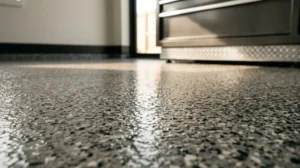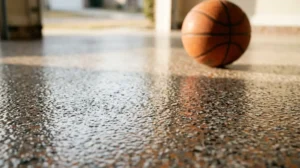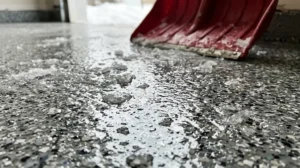
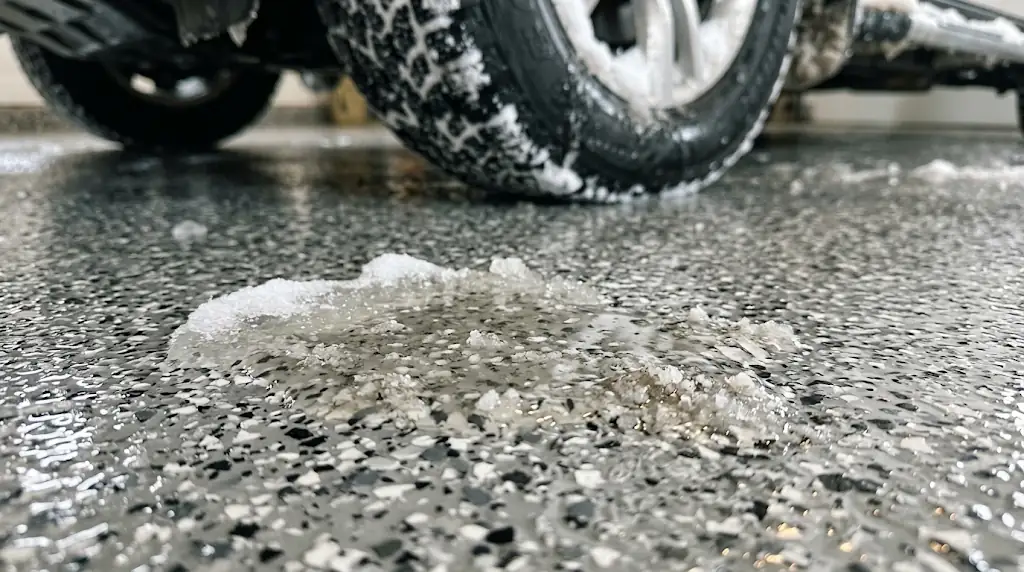
Professionally installed epoxy and polyaspartic floors hold up exceptionally well to road salt, liquid brine, and extreme winter weather in the KC Metro. The heavy-duty coating creates a completely waterproof, non-porous barrier that prevents corrosive street salts and melting snow from penetrating and permanently destroying your concrete garage slab.
Bare concrete acts like a hard sponge. When you park a snow-covered car inside a Johnson County garage, the melting sludge does not just sit on the surface. It sinks directly into the concrete, bringing destructive chemicals with it. A professional floor coating stops this process immediately, isolating the winter weather above the concrete where it can easily evaporate or be swept away.
The Winter Threat: KC Metro Roads vs. Bare Concrete
Kansas winters require aggressive street treatments to keep traffic moving. Local transportation departments and municipalities rely heavily on chemical de-icers to manage snow and ice.
Here is exactly what is being applied to the roads, and consequently, transferred to your garage floor:
- Road crews frequently use salt brine, which is a liquid solution made by mixing water with sodium chloride.
- Crews often spray this salt brine on roadways up to 72 hours before winter weather arrives to pretreat the pavement.
- Salt brine lowers the freezing point of water, making it more difficult for moisture on the pavement to freeze into a solid layer.
- Brine adheres directly to the roadway, which minimizes the amount of material lost from bouncing or blowing away.
- Because liquid salt brine cannot be blown off the road by passing vehicles, it aggressively clings to your car tires and undercarriage.
- Liquid salt brine is worse than plain rock salt regarding corrosive vehicle and property damage.
- Some regional snow contractors utilize a performance-enhanced magnesium chloride brine for their commercial properties.
- Other jurisdictions use an enhanced rock salt mixture to improve melting ability and reduce the corrosion of the rock salt.
Every time you pull into your driveway in Olathe or Lenexa during January, your vehicle is carrying pounds of this highly corrosive, clinging liquid chemical mixture.
Freeze-Thaw Cycles: The Concrete Killer
Sodium chloride brine, magnesium chloride, and standard rock salt all share one common mechanism: they melt snow and ice into a freezing liquid slurry.
If your garage floor is bare concrete, it absorbs that salty water. When the temperature drops overnight in your unheated garage, the trapped water inside the concrete freezes and expands by up to 9%. This internal expansion creates immense hydraulic pressure that literally blows the top layer of your concrete slab apart from the inside out.
This destructive process is called spalling. It leaves your garage floor pitted, heavily cratered, and permanently compromised.
Professional floor coatings eliminate spalling entirely. Because the polyurea or epoxy resin bonds deeply into the concrete and cures into a seamless plastic-like shell, water and chlorides cannot enter the capillaries of the concrete. The moisture remains safely on the surface.
Bare Concrete vs. Polyaspartic Epoxy in Winter Conditions
Understanding how different surfaces handle KC Metro winter elements reveals why protective coatings are structurally necessary.
| Winter Threat | Bare Concrete Slab | Polyaspartic / Epoxy Floor Coating |
| Liquid Salt Brine | Absorbs rapidly. Corrodes the internal rebar and chemically weakens the concrete paste. | 100% impervious. Brine sits on the surface without causing chemical degradation. |
| Melting Snow & Slush | Penetrates pores. Causes extreme freeze-thaw spalling and cracking. | Blocks moisture penetration. Prevents freeze-thaw damage entirely. |
| Road Grime & Oil | Permanently stains. Cannot be fully power-washed out of the porous surface. | Wipes away easily. Oil and grime cannot bond to the synthetic topcoat. |
| Magnesium Chloride | Accelerates surface deterioration and scaling. | Highly resistant to chemical burns. Maintains high-gloss finish. |
Are Epoxy Floors Slippery When Covered in Melting Kansas Snow?
A perfectly smooth, solid-color epoxy floor is dangerously slick when wet. When tires drag snow into the garage, stepping out of your vehicle onto a smooth epoxy surface is a major slip hazard.
To eliminate this danger, high-quality residential garage floors utilize a full-flake broadcast system.
- The installer applies the base coat of epoxy or polyurea.
- Vinyl decorative flakes are broadcast to the point of absolute rejection, covering 100% of the floor.
- Once cured, the excess flake is scraped off.
- A durable polyaspartic clear topcoat is applied over the flakes.
The overlapping vinyl flakes create a heavily textured, “orange peel” profile under the clear coat. This built-in texture provides excellent anti-slip traction, even when your boots are covered in wet Johnson County snow.
Winter Maintenance: Cleaning Salt Off Your Garage Floor
Cleaning winter sludge off bare concrete is impossible because the dirt is inside the concrete. Cleaning an epoxy floor takes minutes. The waterproof barrier means nothing sticks permanently.
Follow these exact steps to maintain your floor during the winter months:
- Sweep Out Heavy Debris: Use a stiff-bristled push broom to sweep dried salt crystals and sand out of the garage.
- Squeegee the Slush: Use a wide foam squeegee to push standing water and melted snow directly out the garage door.
- Mop with Warm Water: Mix warm water with a half-cup of simple, non-sudsing ammonia or a specialized pH-neutral floor cleaner.
- Avoid Soap: Never use dish soap or heavy detergents. Soap leaves a microscopic film on the floor that becomes incredibly slippery when wet and attracts dirt.
- Spot Clean Spills: Wipe up concentrated antifreeze or oil drips with a simple paper towel.
Can You Install Epoxy During a Kansas City Winter?
Yes, but only if you use the correct chemistry. Standard epoxies require temperatures well above 50°F to cure properly. If applied in cold weather, standard epoxy becomes viscous, fails to bond to the concrete, and cures cloudy.
Professional installers switch to polyaspartic coatings for winter installations. Polyaspartic is a rapid-curing aliphatic polyurea that cures catalytically rather than relying on ambient heat. A trained crew can properly install a polyaspartic floor system even when the temperature in Overland Park drops below freezing. The resulting floor is stronger, highly flexible, and 100% UV stable.
Protect Your Garage This Winter
Leaving your concrete exposed to the harsh realities of liquid salt brines and extreme freeze-thaw cycles guarantees eventual structural failure. A professional floor coating is not just an aesthetic upgrade; it is mandatory armor for your concrete.
To ensure your floor survives the next KC Metro winter, contact Olathe Epoxy Flooring today. We install industrial-grade, winter-ready floor systems engineered for local conditions. Visit our contact page to schedule your free on-site measurement and consultation.